Hey, I think, I have a European beach, that I recently acquired because I fell in love with it’s looks and had no idea about the species at all  besides the leaves looked great and the tree gave me prehistoric vibes. Ok so my question is. Are they fast water moving deciduous, like maples, or slow like oaks. With a bit of research. I found out Fagus were in the same family as oak but I was kinda watering the same as my maples for the past two weeks tho I think I maybe over watering a bit due to it’s nature. I worry because you don’t know what u don’t know lol and really wanna give this one the best life. So if anyway if anyone has some insight that would be much appreciated:)
Do you have any pictures of that tree?
Fagus sylvatica in general behaves rather like an oak than like a maple. It is not as vigorous as maples and leaves out rather late in the year. It also tends to react somewhat unpredictable to post harden pruning, some people say you can prune it several times a year, others wait in vain for a second flush. What’s special about beeches is that they are able to stand in full shade without any detriments but slow and stunted growth. They can as well stand in full sun, where they grow a lot more vigorously. However, they do not like very hot temperatures and low humidity and react to conditions like that with burnt leaf tips, especially in combination with intense sun. That’s especially true for the variety with red leafs (it is called a “Blood beech” in German) that can easily be burnt by too much sunlight and thrives better in semi- to full shade. Shade cloth in summer is in almost all cases a good idea for beeches. They are in general very frost hardy but their roots are vulnerable to temperatus below 15°F.
Hope that helps.
2 Likes
Oh, and waterwise they like it constantly moist but not soaking wet. Generally I’d say they like a little more moisture then oaks and a little less then maples but also there are so many oak and maple species with different needs that you cannot really generalize that.
1 Like
Agree with everything above. Figured I’d toss in some soil reference points. I have had a few in 100% akadama and they done equally as well 3-1-1mix. I love all fagus and am surrounded by beech (fagus grandifolia) Forrest that are quickly dying out, so I ended up getting rid of my bonsai ones because there is no way for them to not get BLD and/or BBD. share a pick of your tree if you have one!
2 Likes
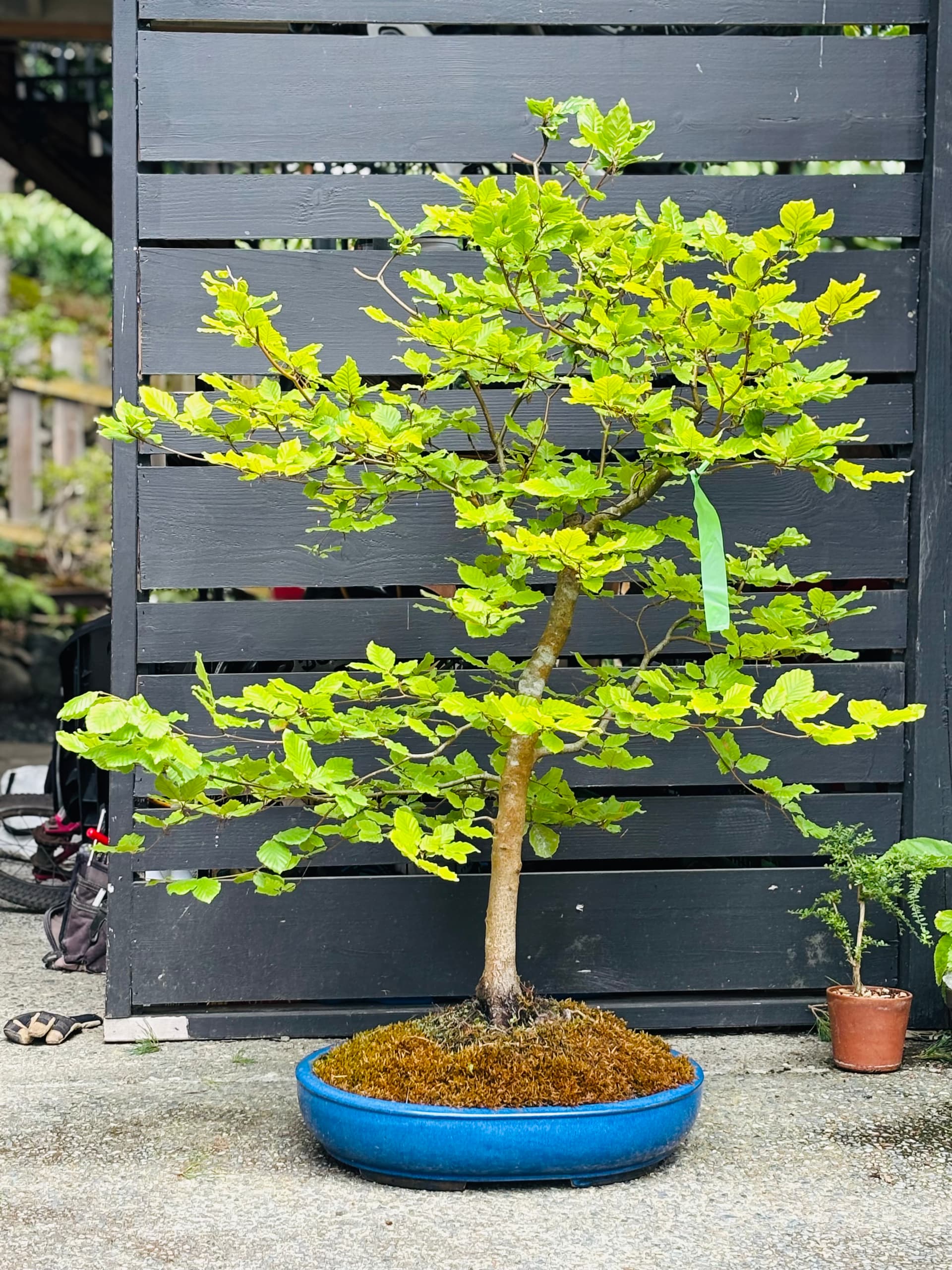
Hey, thanks a lot. That helps a ton I appreciate it. The photo is from a month ago when I bought it. The guy said he bought them as seedlings in the late 90’s n field grew them for a few years before potting them up then eventually to a bonsai pot he said about 2-3 years in this blue pot here. It gets lots of humidity here on van island. Was hoping to repot in spring getting it into some akadama pumice mix hopefully getting it a bit lower in the pot and with a bit of a spin I think the root base will look a lot better. Think it has the starting of a “chicken foot” so I figure roots will be my biggest hurdle with this one. But it’s still young and I’m just happy to have a tree that’s this species. Thanks for all your info was much appreciated I think I have a better grasp on the species already thanks to you guys.
1 Like
That looks very much like a european beech. Can’t tell for sure though because I am not familiar with your american species.
What you might take into consideration for its design: Typically beeches growing in nature have a rather steep angle of branching (in contrast to oaks). When they grow in dense forrests, they normally have upright, tall and slender trunks with branches only occuring very high. If they grow in the open field it is a different story though. There they normally branch out quite low and get a very broad, almost round crown. I’ve found some pictures of famous german beeches for you for some inspiration.
If you want to learn more about how this species behaves in nature I can also reccomend the book “Hidden life of trees” by Peter Wohlleben. He has written a lot of books and all of them are worth reading in my opinion. His favourite subject to write about is beeches.


Oh, and be careful with wire. Whatever scar you leave on the bark of a beech, you leave it there forever. That’s why they are a favourite for people who want to carve their initials or other petty messages unto a tree.
Awesome. Ok thanks. I appreciate all the info. I knew I came to the right place 
